 |
 |
|
|
Pyotr Velikiy Class and Constitution Class
 Diagrams
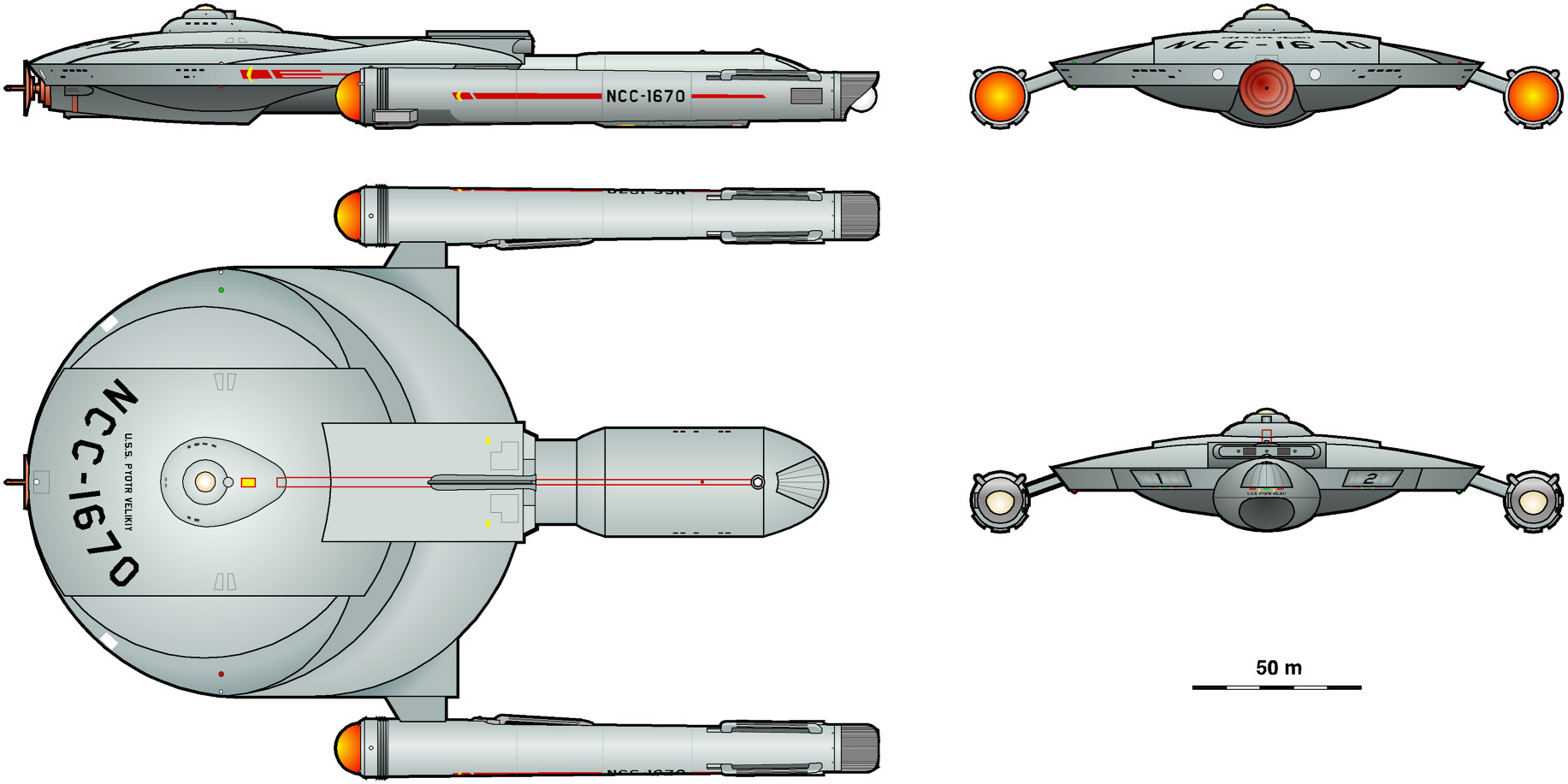 Pyotr Velikiy |
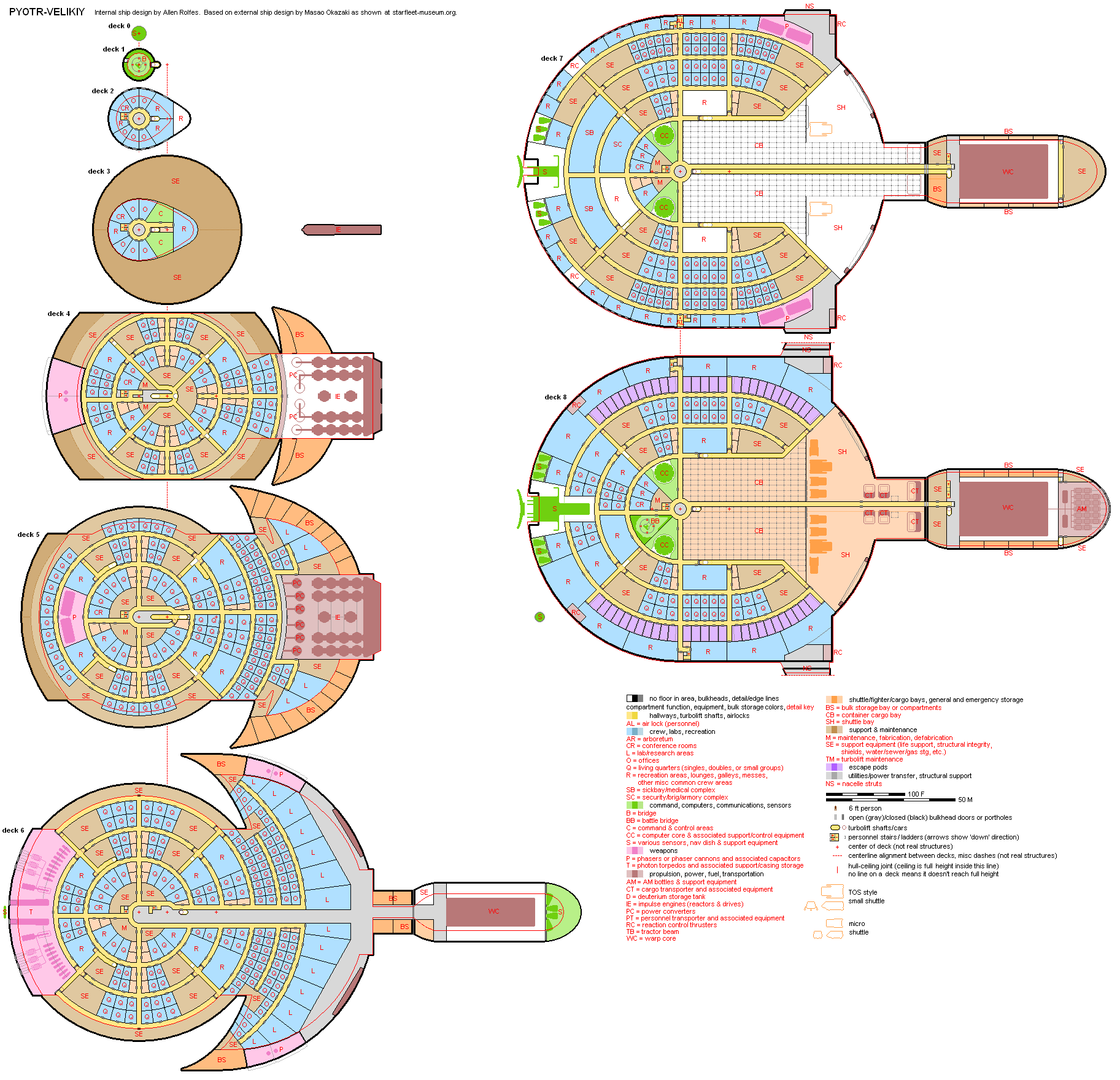 Pyotr Velikiy deck plans, part 1 created by Allen Rolfes (see notes) |
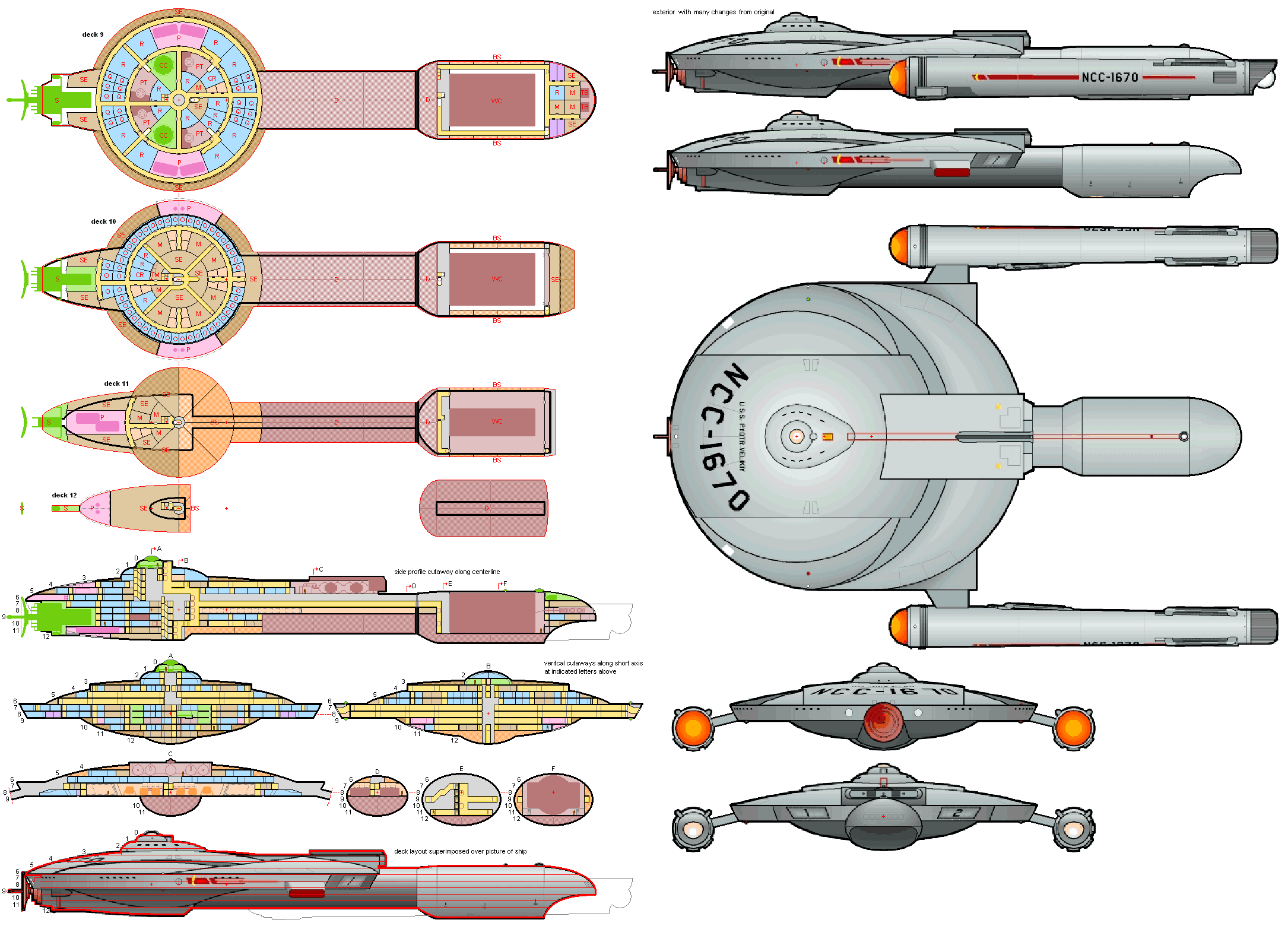 Pyotr Velikiy deck plans, part 2 created by Allen Rolfes (see notes) |
 Pyotr Velikiy tug |
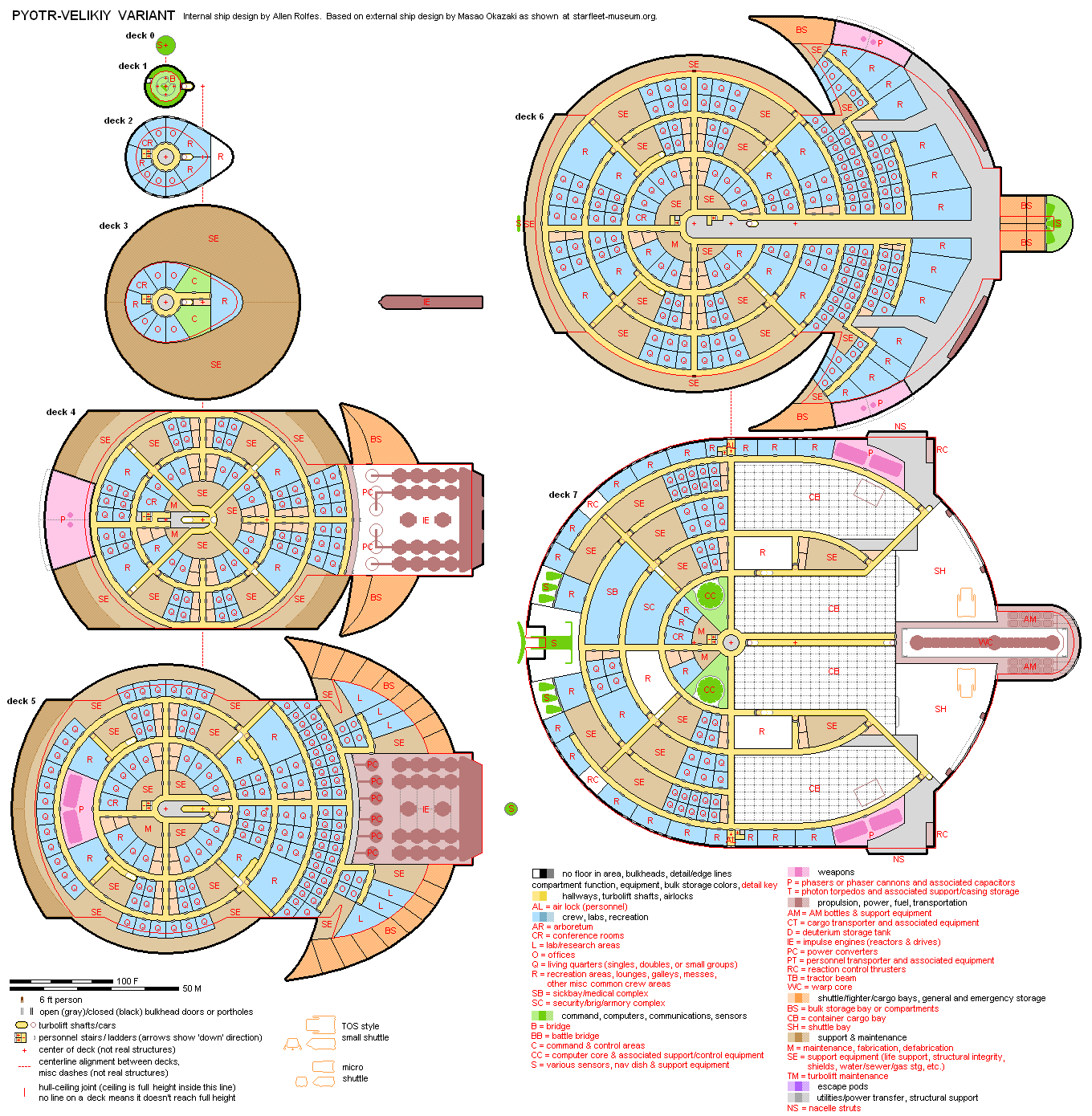 Pyotr Velikiy tug plans, part 1 created by Allen Rolfes (see notes) |
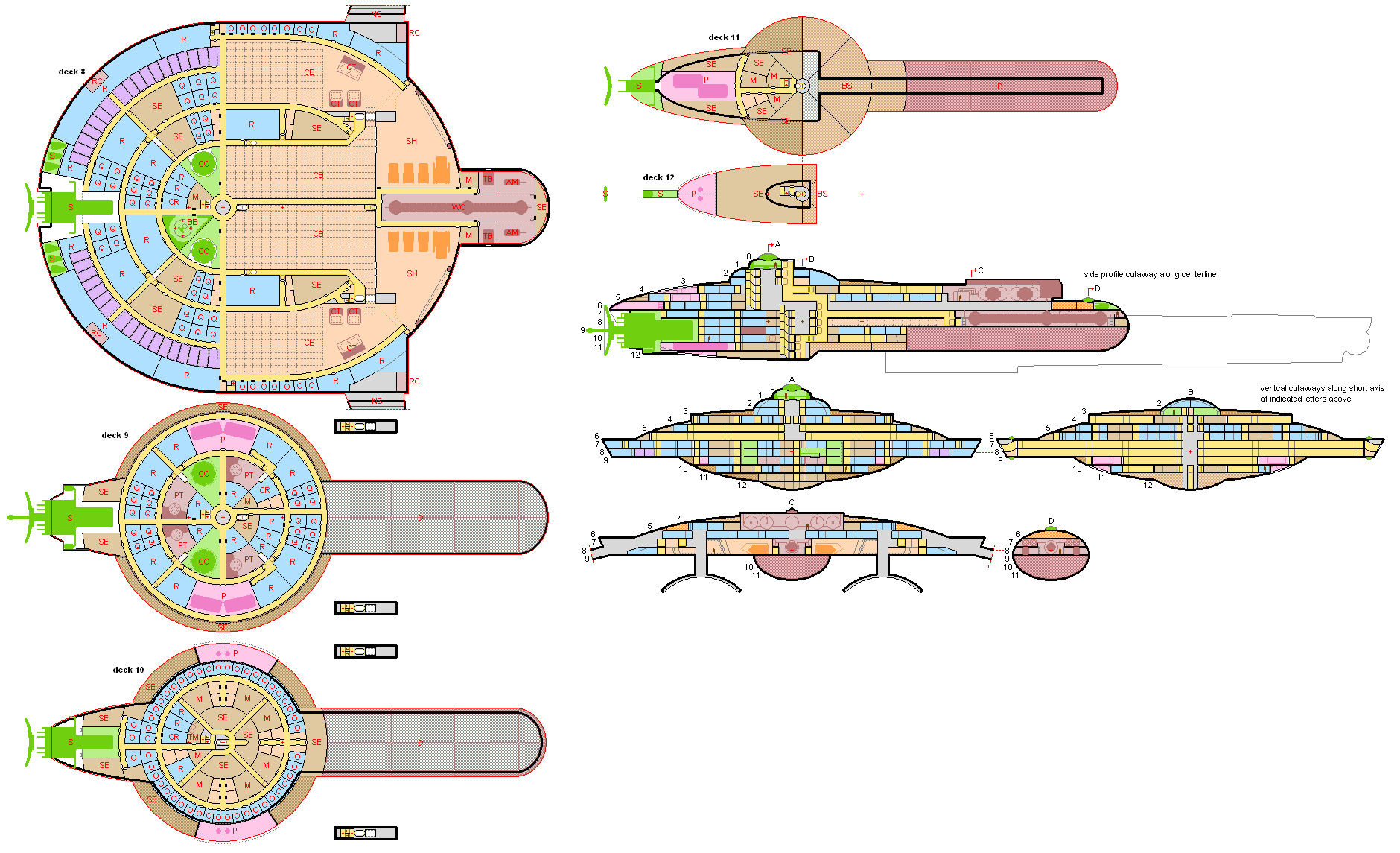 Pyotr Velikiy tug plans, part 2 created by Allen Rolfes (see notes) |
 Constitution |
 Constitution deck plans, part 1 created by Allen Rolfes (see notes) |
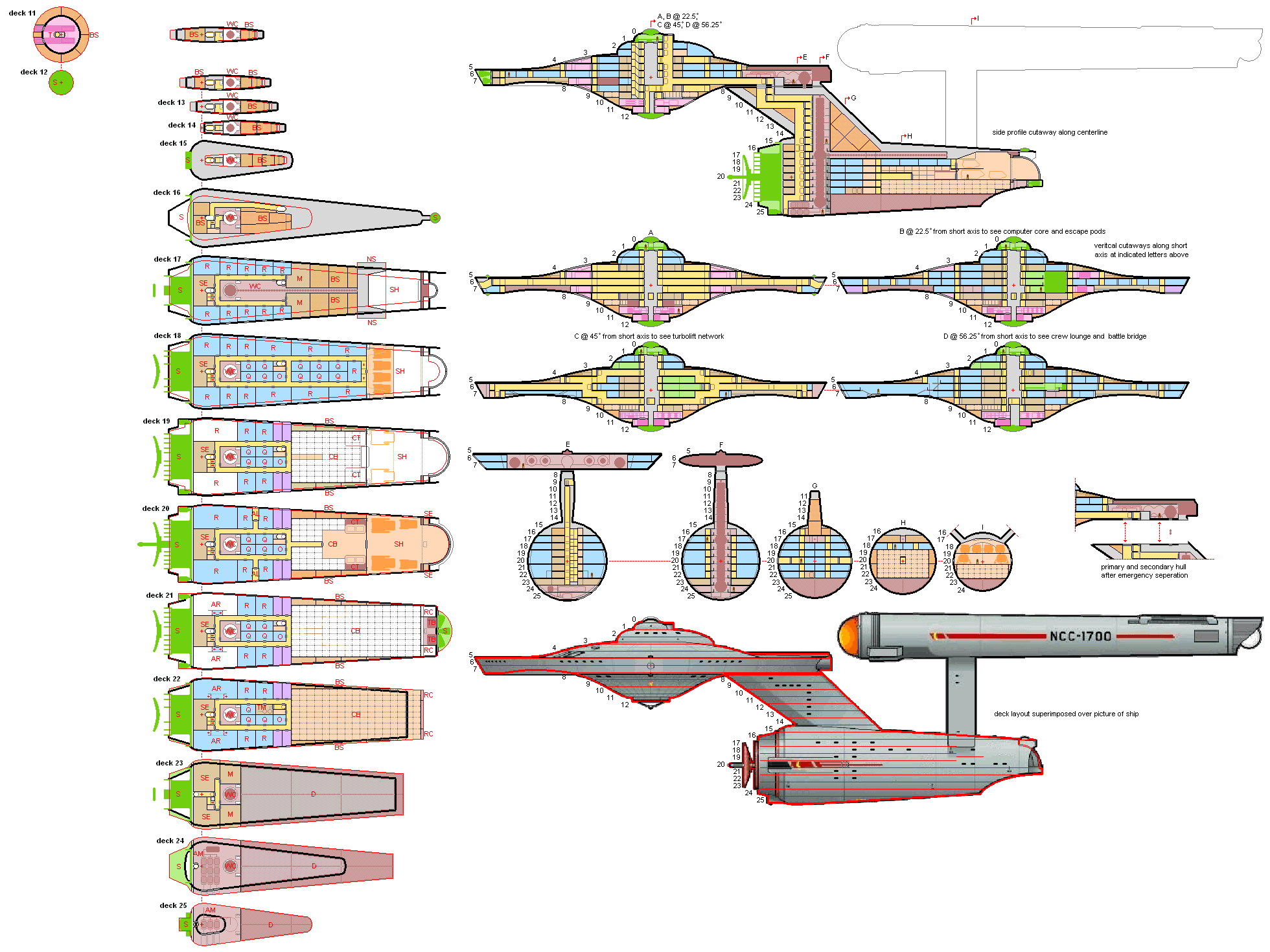 Constitution deck plans, part 2 created by Allen Rolfes (see notes) |
 Constitution refit plans, part 1 created by Allen Rolfes (see notes) |
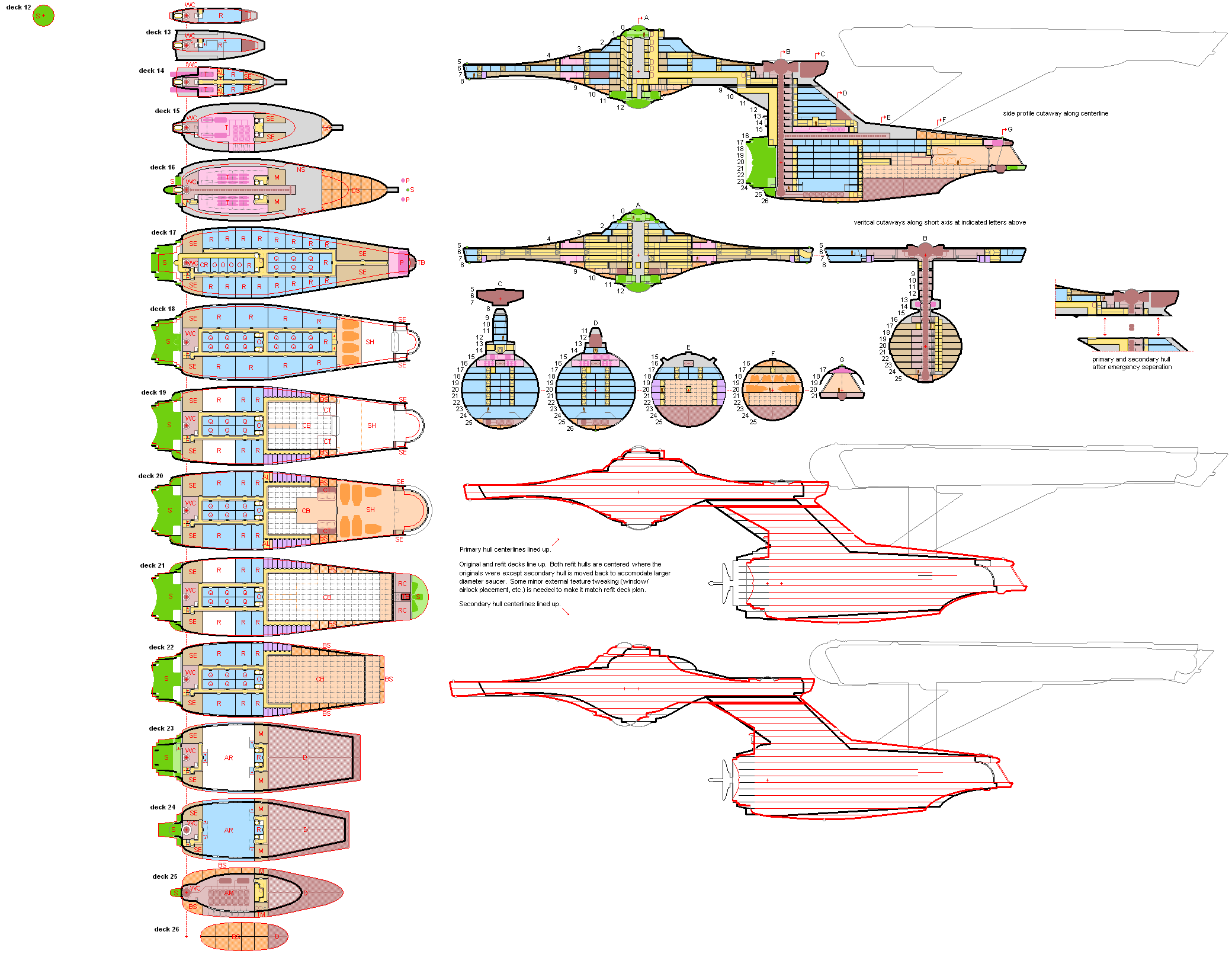 Constitution refit plans, part 2 created by Allen Rolfes (see notes) |
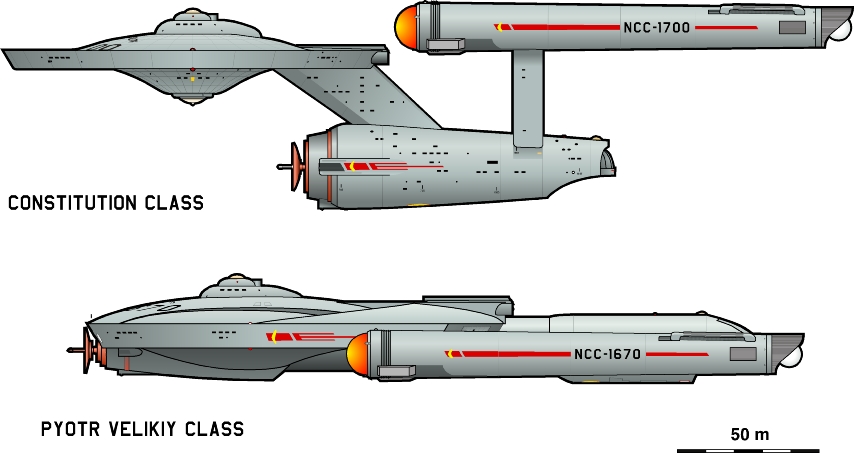 Constitution and Pyotr Velikiy |
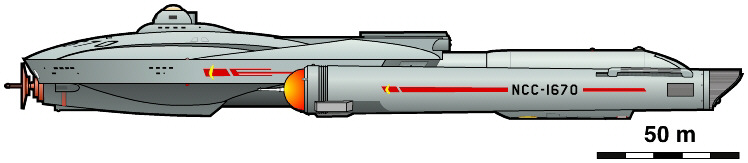 Pyotr Velikiy prototype |
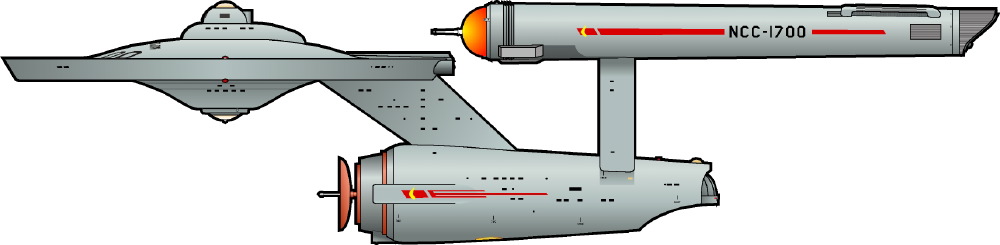 Constitution prototype |
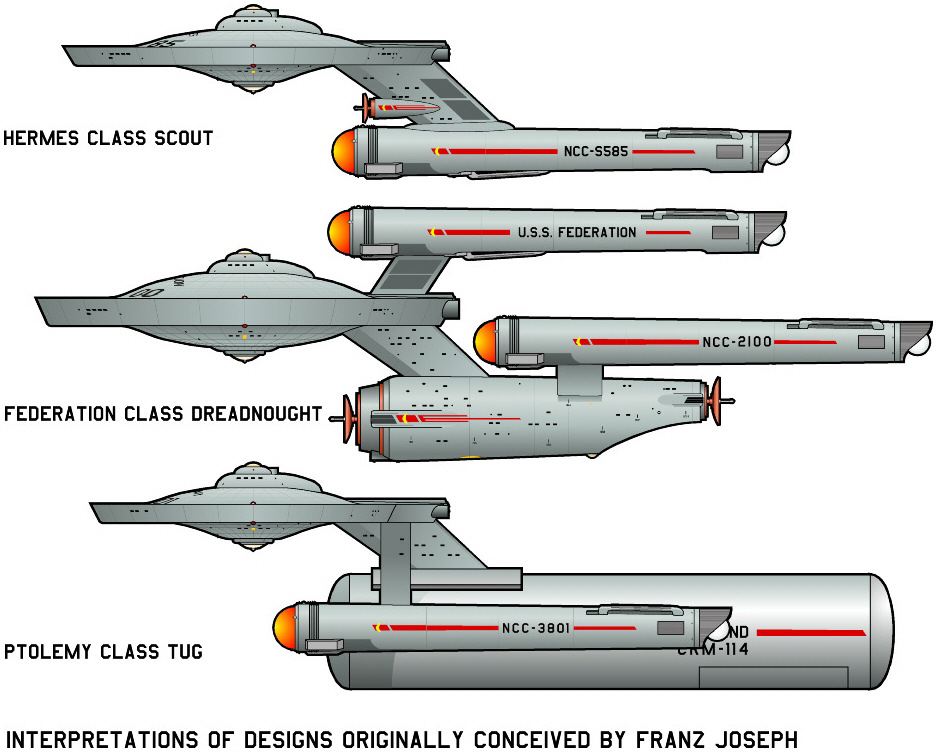 Classes derived from Constitution Interpretations of designs originally conceived by Franz Joseph |
Scenes
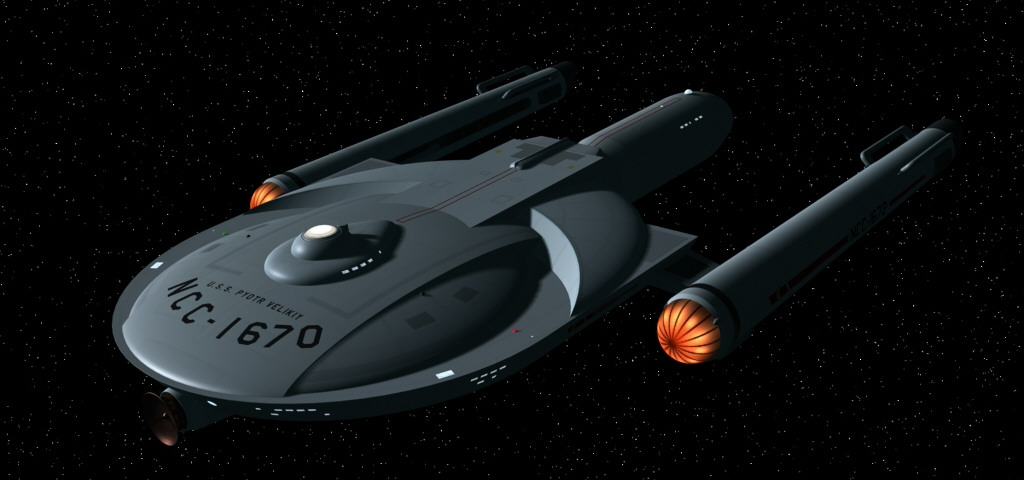 Pyotr Velikiy 3D scene created by Thomas Pemberton |
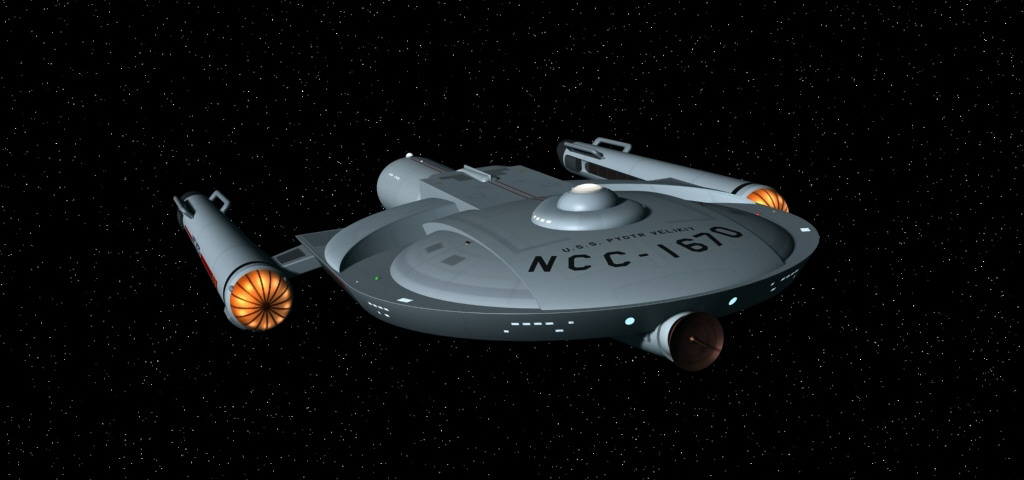 Pyotr Velikiy 3D scene created by Thomas Pemberton |
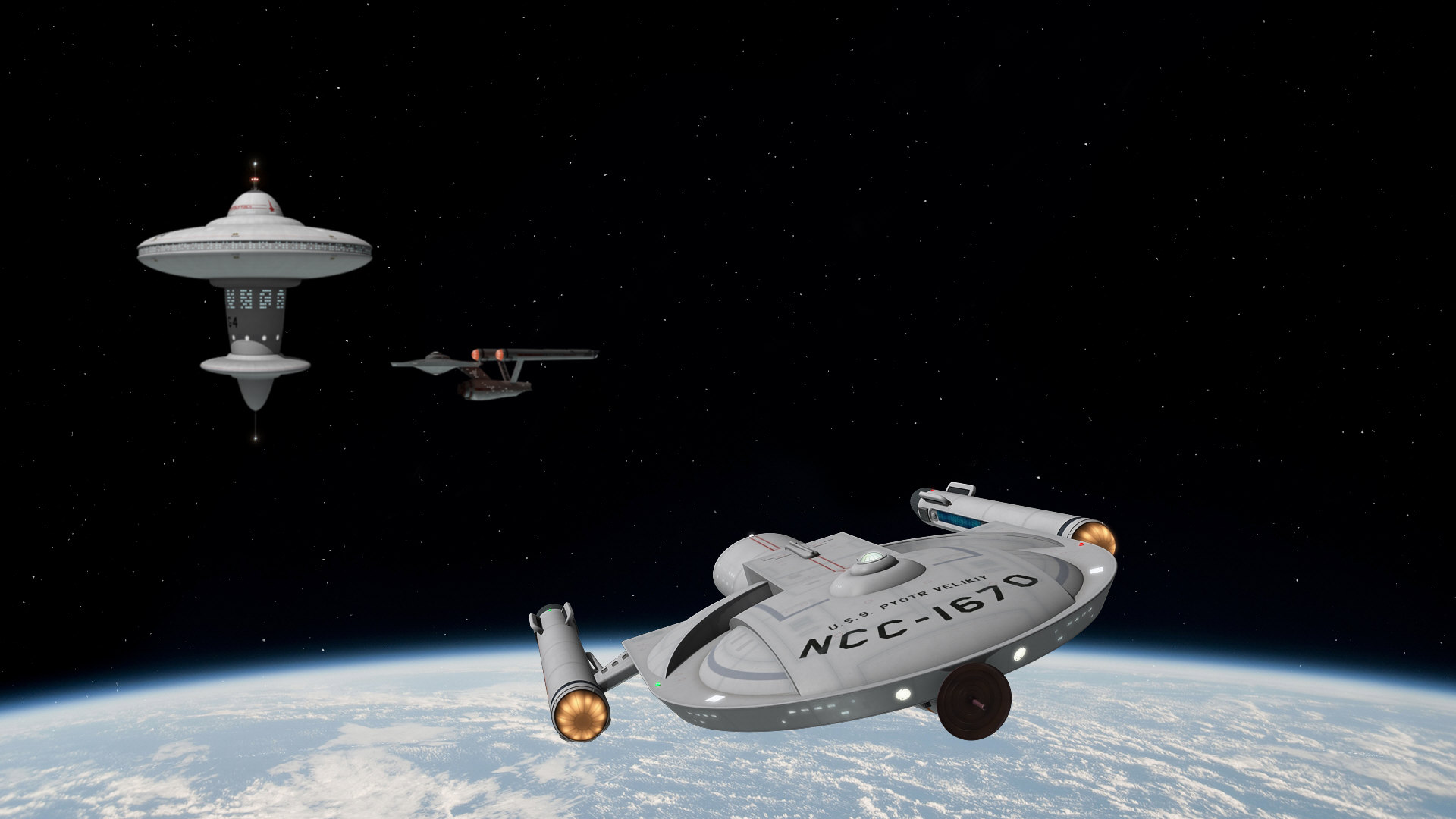 Pyotr Velikiy with G4 station created by Thomas Pemberton |
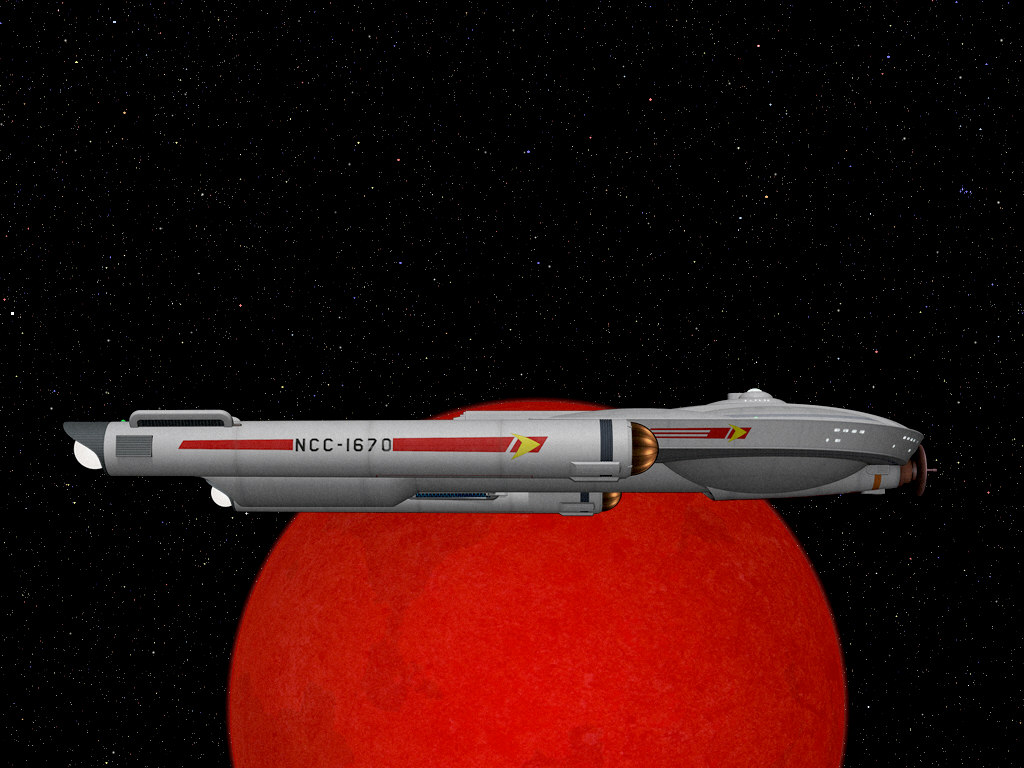 Pyotr Velikiy in orbit, TOS credits style created by Thomas Pemberton |
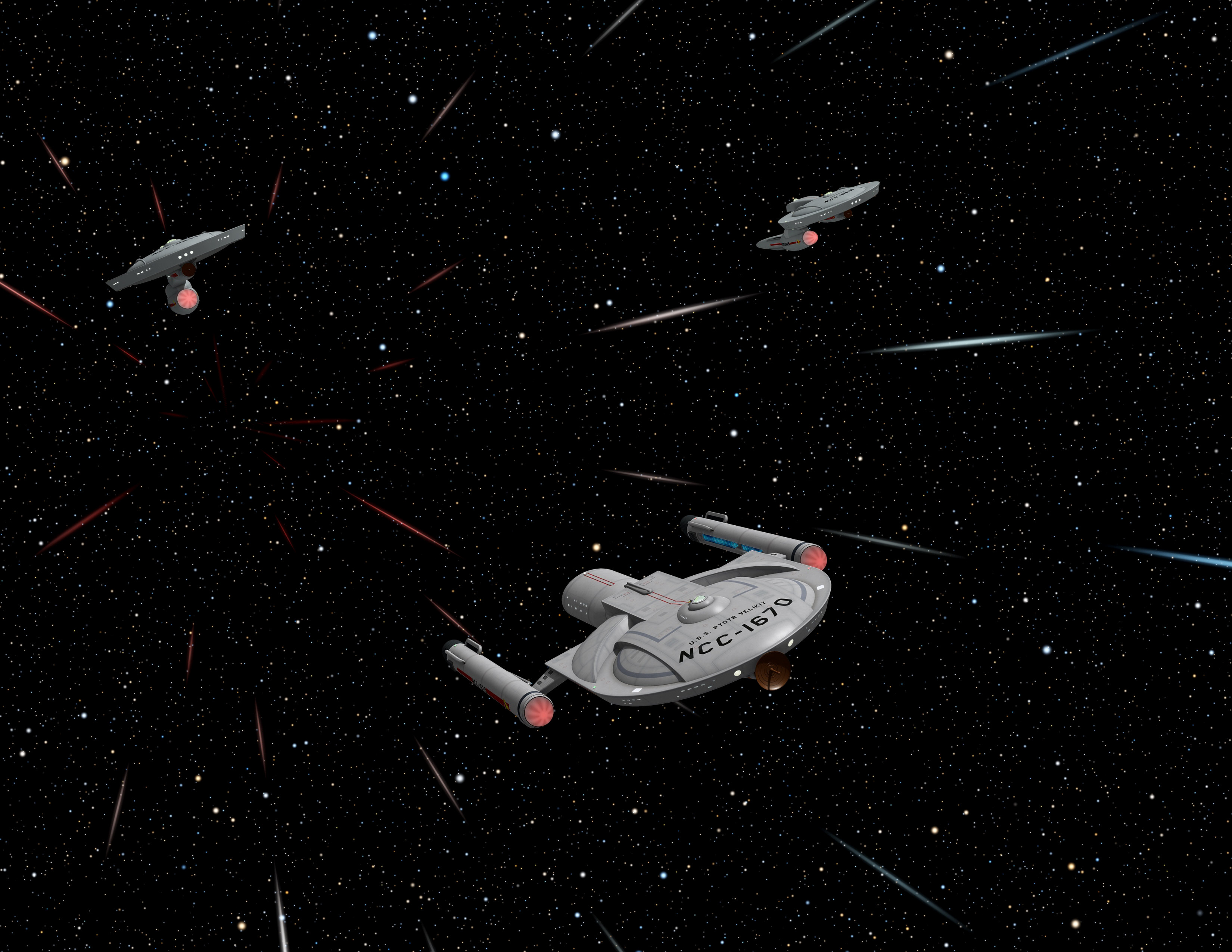 Pyotr Velikiy escorted created by Thomas Pemberton |
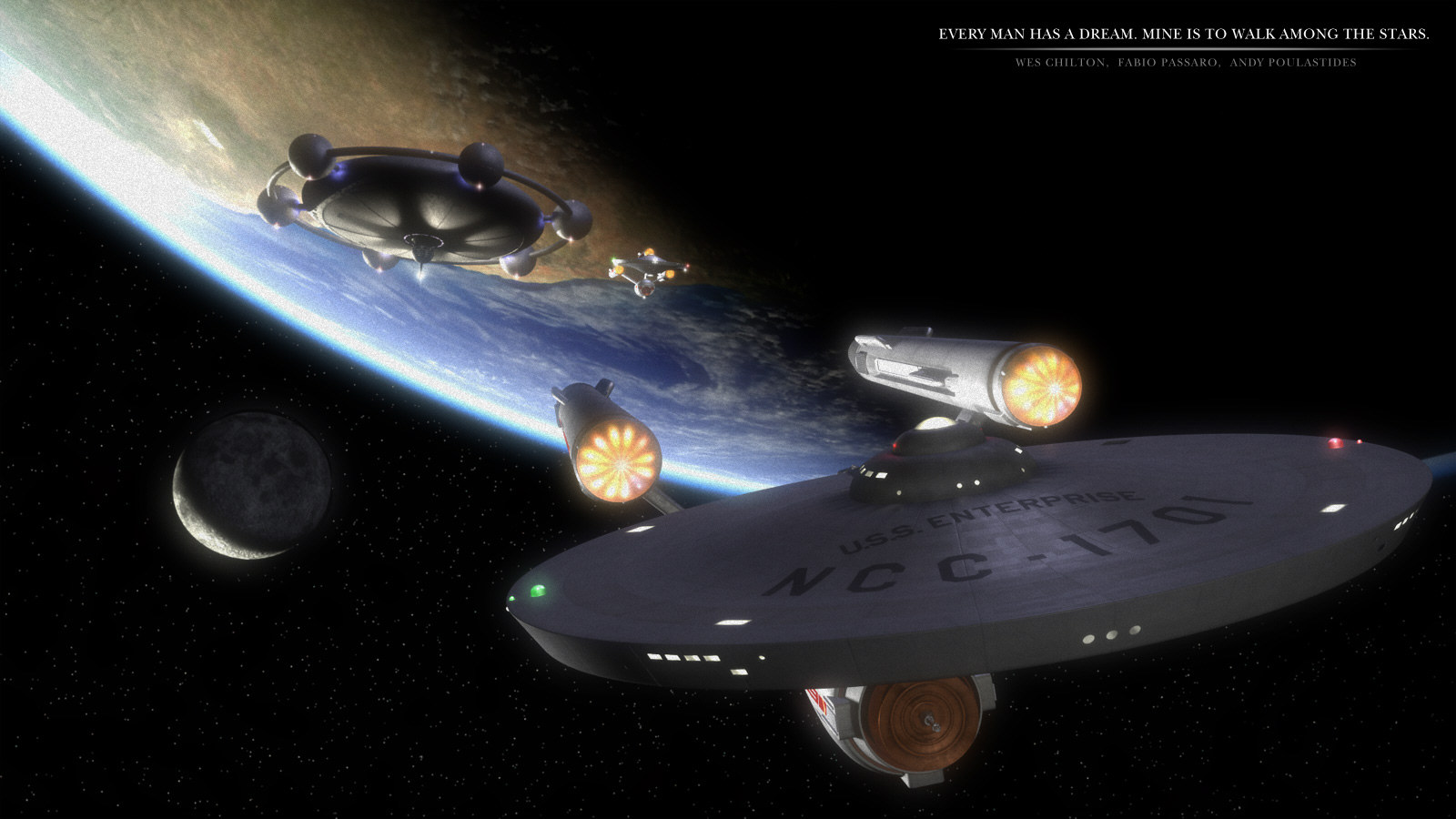 NCC-1701 at Starfleet Headquarters created by Wes Chilton |
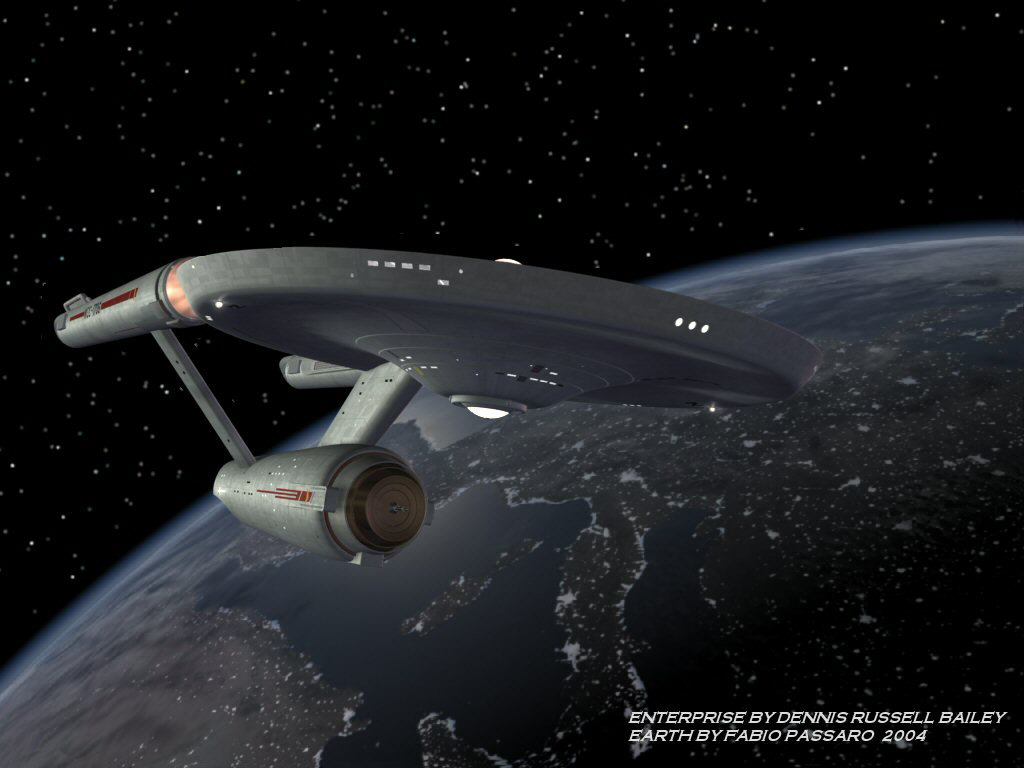 NCC-1701 in Earth orbit created by Dennis Bailey |
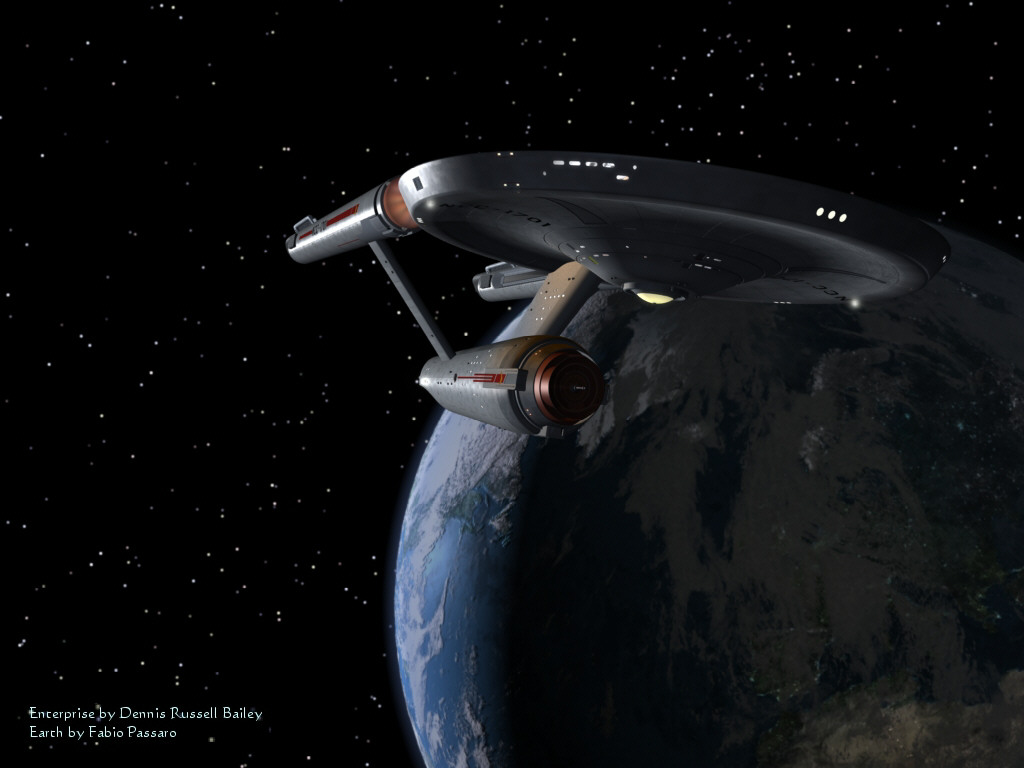 NCC-1701 in planet orbit created by Dennis Bailey |
 NCC-1701 at Deep Space K-7 created by Nick Porcino |
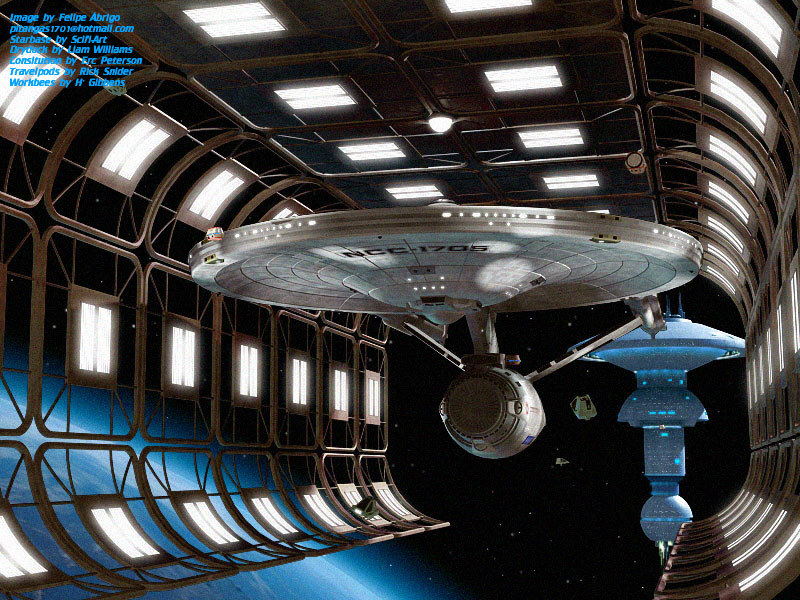 NCC-1705 in drydock created by Felipe Abrigo |
History
The Federation and Starfleet at 75 Years
The year 2236 marked the 75th anniversary of the United Federation of Planets (UFP). Although the Federation continued to have disputes with several other regional and local powers (including the Klingons, the Kzinti, the Orions, and the Tazzi), none of these conflicts threatened to escalate to full-scale war. Starfleet, also celebrating its 75th year, was an important reason for these long years of peace. The fleet's powerful warships and explorers discouraged most potential foes from directly challenging the Federation. Starfleet's primary front-line cruisers in 2236 were the ships of the Valley Forge class. In service for less than 10 years, Valley Forges continued to enjoy a superiority over comparable ships of the Klingons and other hostile powers. The 44-ship class had performed admirably in missions of exploration, diplomacy, and defense throughout the Federation and outside its borders.
However, Starfleet was already looking beyond the Valley Forge class to the production of a more powerful "supercruiser" able to undertake missions even further beyond the borders of the Federation. Recent breakthroughs in weaponry, sensors, and propulsion suggested to Starfleet Command that 20 years, the average interval between the introduction of main cruiser classes, was too long a wait for Valley Forge's successor. Although Valley Forges were generally regarded as extremely fine ships that were expected to lead Starfleet into the second half of the 23rd century, their designed capabilities had been constrained by financial considerations during their development in the early 2220s, a time when the Federation feared a coming era of "imperial overreach." However, with the Federation's most dangerous potential adversary, the Klingon Empire, only now slowly rebuilding itself after yet another period of self-destructive internal strife, the Federation felt confident enough to once again seek out new life and new civilizations far beyond its well-defended borders.
Two Heavy Cruisers: An Heir and a Spare
In October 2236, Starfleet's Ship Specifications Review Board, in San Francisco for festivities marking Starfleet's 75th year, convened at Fleet Headquarters to discuss the possibility of constructing a successor to Valley Forge. The projected new class was to have greatly improved speed, range, firepower, and scientific facilities and be able to undertake unsupported missions lasting five years with a crew of more than 400. Such a ship would displace some 200,000 t and be significantly larger than Valley Forge (which displaced 136,000 t). Most of the Board's technical subcommittees were confident that the design and construction of the lead ship of a new class could be completed by 2241, barring unforeseen technical roadblocks. However, whether such a new ship was possible depended in large part on its matter/antimatter (M/AM) reactor. Previous ships of this size (such as Quetzalcoatl and Siegfried) had been underpowered, unwieldy behemoths rather than the wf-7 superships that Starfleet had hoped for.
Representatives from Hellas Planitia, Mars, the site of Starfleet's main M/AM laboratory, reported results of preliminary computer studies for a new reactor, the SSWR-XV, which was to exploit recently developed theories for increasing the efficiency of M/AM interaction. Instead of using a large, open cavity where the reactants are injected and annihilate each other based on random molecular contact, two long magnetic constrictors fed fuel into a much smaller reaction chamber, where a centrally mounted dilithium crystal focused the reactants to annihilate in a more precise and controlled reaction. Hellas Planitia engineers hoped to at least double reactor output and endurance while reducing reactor size by 50%. Such improvements in reactor performance, along with enormous new nacelles already on the drawing board, would finally enable the construction of a heavily armed wf-7 exploratory cruiser, which Starfleet had been attempting to develop, without success, for the last 30 years. The Hellas Planitia engineers assured the board that the new SSWR-XV reactor would be ready for production in 2241, allowing a new ship built around the reactor to enter Starfleet service by 2242.
Although the new ship would rely largely on evolutionary refinements of technology already in use, its development was not without risks. In particular, some members of the board were concerned that the feasibility of this large new cruiser should hinge on the development of a reactor that existed only as a computer model and was at least five years away from delivery. Despite the assurances of Hellas Planitia engineers, their developmental forecasts had often proved unrealistically optimistic and minimized the difficulty of overcoming obstacles, which were often not initially apparent. (Indeed, Hellas Planitia engineers confidently reported that the reactor had already been designed and was functional and simply needed to be reconstructed physically.)
To ensure that a new exploratory heavy cruiser would be in service with Starfleet by 2242, Admiral Shrelev IV of Andor suggested that a second ship project involving less risk be undertaken with a reactor expected to be available in the near term rather than half a decade away, if ever. Admiral Shrelev IV suggested that this second ship be built around a new version of the SSWR-XIII reactor, which was then in the advanced stages of physical testing at Hellas Planitia and slated for refit into Valley Forge-class ships in 2238. A scaled-up version of this reactor might easily achieve output levels, if not efficiency and compactness, approaching those projected for the SSWR-XV.
By the end of 2236, Starfleet Command had issued directives for the development of two new classes of heavy cruiser. The first, to be called Constitution (NX-1700) after the famed wooden frigate of the 18th century (still afloat at Boston after 450 years), was to use the new SSWR-XV reactor and employ the time-tested layout—a command hull disc connected by a thin neck to a engineering hull supporting two nacelles—used for most first-line Starfleet cruisers for the past 75 years. The second class of heavy cruiser, to be called Pyotr Velikiy (NX-1670) after the czar who created Russia's Imperial Fleet, was to be designed according to Andorian design principles around a second new reactor, the SSWR-XIII-B, based upon the reactor, now designated SSWR-XIII-A, already in development for the Valley Forge class. Production of the Pyotr Velikiy class would continue past the first ship only if the Constitution project failed or was significantly delayed.
To simplify the design processes as much as possible, both Constitution and Pyotr Velikiy were to use several common components, including the main navigational deflector and sensor suite, weaponry (both beam and projectile), deflector shielding and defensive systems, bridge module, life-support systems, warp nacelles, and computer systems. Of these components, the final two were most notable. The Sabre nacelles were not of revolutionary design but were extremely large, both in terms of overall length (155 m) and as a percentage of each ship's projected displacement. They were designed to handle extremely high warp-plasma pressures; in theory, they would allow a Constitution-class ship to achieve speeds as high as wf 12, were sufficient power available. Construction of the enormous nacelles required the development of specialized centrifugal forges to produce the extremely large warp coils of unprecedented purity. The computer system was developed by wunderkind designer Dr. Richard Daystrom based on his duotronics theories. In 2243 at the age of 24 years Dr. Daystrom would win the Zee-Magnees prize for his groundbreaking work in logic systems.
Work on Pyotr Velikiy Starts on Andor
The Pyotr Velikiy project was an enormous coup for Admiral Shrelev IV and the Andorian shipbuilding industry. Andorian shipyards had previously constructed Starfleet light cruisers and scouts, such as those of the Kestrel and Capella classes, but had never both designed and built a more prestigious heavy cruiser class. Granted, Pyotr Velikiy was intended at the outset merely as insurance against the possible delay or failure of the Constitution class and was not guaranteed to enter production beyond the lead ship. However, Admiral Shrelev IV was confident that if the Andorians were to design and build a superior ship, Starfleet would have no choice but to allow production of at least a small number of Pyotr Velikiy-class ships, regardless of the status of the Constitution project. Starfleet had first suggested that Pyotr Velikiy be developed by Andorian staff in San Francisco and built at Utopia Planitia, Mars, so as to increase cooperation between the parallel project teams. However, Admiral Shrelev IV lobbied strongly for the Pyotr Velikiy to be both designed and built at Andor so that resources and facilities built there could strengthen the Andorian shipbuilding industry. He also argued that dispersing shipbuilding throughout the Federation, rather than concentrating it dangerously in the Sol system, made sense from a strategic point of view. An added advantage of basing the Pyotr Velikiy project at Andor was that Starfleet oversight was lessened, freeing Andorian engineers to pursue their traditional design solutions to warp flight.
Andorian starships have traditionally been built with a single, flattened hull confined to the horizontal plane with integrated nacelles; in contrast, starships designed on Earth in the last 75 years featured both a disc-shaped command hull and a dependent engineering hull with nacelles on long supports. Andorian warp field theorists felt that the greater cruising efficiency of a warp field with a minimal frontal profile outweighed the disadvantages of lower rates of roll, pitch, and yaw than with a bi-level warp field favored by Earth designers. Accordingly, Pyotr Velikiy featured a command hull 142-m-long and 123-m-wide with nacelles attached at the rear quarters with extremely short outboard supports. The dorsal hull had a laterally delaminated command promontory whose outer layers were removed outboard to reveal a smaller-diameter promontory underneath. A similar structure had been used for the Capella-class scout and found beneficial for refining boundary-layer transhull warp-field dynamics. Behind the main promontory was a semilunar "collar" holding additional crew spaces and laboratories. The main navigational deflector traded a large frontal profile for a longer resonance tunnel and was attached to the front ventral part of the command hull. The SSWR-XIII-B M/AM reactor was too large to integrate into the command hull and was placed, along with its associated fuel stores, in a separate engineering hull connected directly aft by a short, thick neck. Twin main shuttlecraft bays straddled the root of the neck, while a third, smaller shuttlebay was placed at the stern of the engineering hull.
Because the Pyotr Velikiy class, like the Constitution class, was intended to explore far beyond the borders of the Federation on independent missions lasting as long as five years, maintenance of warp capability far from support facilities was a primary concern. Although Federation M/AM reactors had generally proven extremely reliable, the projected demands on the warp drive of the new classes were unprecedented. However, because Pyotr Velikiy's SSWR-XIII-B reactor was expected to be less powerful than Constitution's advanced SSWR-XV reactor, it would need to operate at higher percentages of maximal output to achieve desired cruising speeds. Starfleet feared that such stressful operating conditions would increase the risk of a reactor malfunction, which might strand a ship hundreds of light-years from Federation space. Against such an eventuality, Pyotr Velikiy's warp drive was designed to be operable at lower speeds (wf 3.2) on fusion power alone. For this reason, the "impulse" system of Pyotr Velikiy was abnormally large (60 m long) and powerful and was supplied by two large deuterium tanks in the rear ventral command hull. If the M/AM drive were to experience irreparable malfunction or complete failure, the now-redundant engineering hull would be detached to decrease weight. The nacelles, which were attached directly to the command hull, could continue emergency warp operations with power from the fusion reactor. The fusion reaction could also be used to supplement the M/AM reactor to achieve higher warp speeds. Because she carried both a high-output fusion reactor system and a larger, less efficient M/AM reactor, Pyotr Velikiy was an extremely large ship, displacing some 280,000 t, versus 190,000 t for Constitution.
This degree of redundancy in the warp-drive system had not been employed in Earth-designed military starships since the Earth-Romulan War (most notably by Yorktown-class carriers, which operated deep within enemy space) but was still common at this time in Klingon ships. For example, the Klingon D5-class cruiser, introduced in 2224, had carried a large fusion reactor to allow routine maintenance of its main M/AM reactor while traveling at warp speeds, and the D7-class cruiser, introduced in 2250, had twin M/AM reactors. That such redundancy was required for Pyotr Velikiy reflected in part how revolutionary Constitution and its new reactor were to be.
The development and construction of Pyotr Velikiy proceeded quickly and without major difficulties. Indeed, Pyotr Velikiy had already been flight-tested at warp speeds with temporary Merlin II nacelles (the type used by Valley Forge and related classes) and power from its fusion reactor alone in December 2238, less than two years into development. In April 2239, the main SSWR-XIII-B M/AM reactor arrived from Hellas Planitia and was installed in the secondary hull of Pyotr Velikiy. The Sabre nacelles, delayed because of impurities causing microfractures in their large warp coils, were finally attached to Pyotr Velikiy in September 2239. Static testing soon began but revealed some minor problems related to the extreme intrahull length of the plasma conduits. After additional conduit shielding was installed, Pyotr Velikiy began full-up flight-testing and in July 2240 reached a speed of wf 8.1, which compared with Valley Forge's top speed of wf 7.6. Pyotr Velikiy (NCC-1670) was officially handed over to Starfleet in a ceremony at its Orbital Headquarters above San Francisco in March 2241, just as troubles with the Constitution project began to surface.
Constitution's Troubled Development
From 2237 to 2240 design and construction of the spaceframes of USS Constitution and the following 4 ships of the class proceeded smoothly in orbit above San Francisco. Although considerably larger than Valley Forge, Constitution was not significantly more complex, outside of its main M/AM reactor and warp nacelles. The 129-m-diameter primary hull with asymmetrical promontories carried the updated bridge module, an enlarged sickbay, the duotronic computer core, extensive scientific laboratories, and spacious berths for officers, crew, and diplomatic guests (including those not from class M planets). All phaser emitter ports and torpedo tubes were concealed behind retractable hull plates. A large sensor in the ventral promontory allowed Constitution to scan deep below planetary surfaces from high in geosynchronous orbit. The impulse deck was of a new, compact design and disturbed the smooth contours of the rear primary hull only slightly.

created by Kristian
Trigwell
Constitution's secondary hull, suspended from a deep but strikingly thin connecting dorsal, was fronted by a 28-m-tall mount for the main navigational deflector. The large deflector was necessitated in part by the much higher speeds projected for Constitution. Behind the deflector, the hull tapered back gently for an additional 90 m to the main shuttlecraft bay in the stern. Within the secondary hull were engineering spaces for the warp drive system, including the compact SSWR-XV reactor, deuterium tanks, AM containment bottles, the dilithium control room, and plasma conduits. A large section of the hull was dedicated to cargo bays, workshops, fabrication gins, and recreation facilities.
In late 2240, disturbing rumors began to emerge from Hellas Planitia that all was not well with the SSWR-XV reactor project. Both the SSWR-XV reactor project leader and the director of Hellas Planitia resigned or were dismissed in the spring of 2241 following large-scale staff defections the previous fall. An emergency review by the Federation General Accounting Office in July 2241 revealed that certification tests at several developmental milestones had been partially or completely falsified to give the erroneous impression that development of the reactor was proceeding according to schedule. By this time the reactor should have already been undergoing high-stress endurance testing but not yet even been run at 75% of full power. Problems with the reactor were numerous; perhaps the most severe were power surges and drops during reactor step-up and step-down, the development of retrograde eddies in the plasma swirl chamber, and extremely high rates of dilithium matrix instability. Worst of all, the SSWR-XV, which had been undergoing bench testing at Hellas Planitia since early 2239, was said to be at least 24 months away from spaceframe mating and perhaps 36 months away from full-up flight testing.
The delay of the main power plant rippled outward to affect construction of the Constitution spaceframes at the San Francisco Starfleet Yards and work on other starship projects planned or already in progress. As the delivery date for the SSWR-XV reactor was pushed back months, then years, Constitution's various design and construction teams on the ground and in orbit became dispirited and lost hope that the ship would ever see service. Reports in the popular press harped on the increasing cost of Constitution, funds that might better be spent elsewhere. A large percentage of the design and construction facilities and manpower in the Sol system were now being used by or had been reserved for the Constitution project, but most sat idle. Lawrence Marvick, a young systems engineer in San Francisco, complained that to pass the time he and other engineers ran endless simulations of increasingly unlikely scenarios, such as the crash landing of the command hull on planetary surfaces. If these facilities and manpower were shifted away from Constitution to other starship projects, they might not be available later when the Constitution class finally entered full-scale production. As a result, Constitution's delay slowed all other projects in the Sol system.
As an indication of the importance Starfleet placed on the Constitution, Commodore Robert April, Commander of the 4th Fleet, assumed direct control of the project in August 2241. Rear Admiral Beatrix Nguyen, head of Starfleet Propulsion, was assigned to Hellas Planitia to personally oversee development of the SSWR-XV reactor. With Starfleet oversight and a new sense of direction, the Constitution project again began to move forward, but several valuable years of development had been lost. The 2242 target date for Constitution's joining the fleet was clearly impossible to meet and would likely be missed by additional several years.
What was bad news for Constitution was good news for Pyotr Velikiy. While not wishing to appear to be taking advantage of problems at Hellas Planitia, one of the Federation's most important research centers, in August 2241 Admiral Shrelev IV and the Andorian government quietly began campaigning for early production of additional Pyotr Velikiy ships. However, supporters of shipyards based in the Sol system resisted any diversion of funds, construction facilities, or manpower to the production of what they considered a second-rate "stop-gap" ship. They insisted that any problems with the SSWR-XV reactor and the Constitution project were firmly in the past now that Commodore April was in charge and that full-scale production would soon be underway. The Andorians countered that it was for exactly such a situation that the Pyotr Velikiy project was started and that a failure to begin production of additional Pyotr Velikiy-class ships while the future of Constitution was still in doubt only ensured that Starfleet would have no new heavy exploratory cruisers in 2245, other than Pyotr Velikiy herself.
Pyotr Velikiy Impresses in Service
As the original target date for Constitution to join the fleet came and passed in January 2242, Pyotr Velikiy was showing itself to be an extremely capable and reliable vessel. In service with the 4th Fleet, Commodore April's former command, Pyotr Velikiy undertook the first survey mission beyond the Hammadi-Burke Hollow, an area of dense interstellar matter impenetrable to long-range sensors. On that mission alone, Pyotr Velikiy charted 15 star systems and made successful first contacts with two neighboring, newly warp-capable races, the Laag and the Konnir, previously unknown to the Federation and unknown even to each other before being introduced by Pyotr Velikiy. During speed runs in deep interstellar space, Pyotr Velikiy reached wf 8.5, at the time a record for Starfleet ships.


As word of the success of Pyotr Velikiy spread, sentiment among the fleet's officers and crew grew for the class to enter at least limited production. However, Starfleet Command continued to support production of only Constitution, which it maintained would prove to be the superior ship. However, political forces outside Starfleet pressed for production of Pyotr Velikiy. Chief among these were several races, including the Andorians, the Tellarites, and the Zakdorn, and numerous Earth colonies that sought to break Earth's near-stranglehold on ship construction. They felt that the construction of a major class of heavy cruisers outside the Sol system would lead to the establishment of other Starfleet yards throughout the Federation. Dispersing ship production made good strategic sense, as Admiral Shrelev IV had suggested in 2236, and made good economic sense as well. Bowing to political pressure and sound reasoning, Starfleet and the Federation Council finally decided in November 2243 to construct 5 additional Pyotr Velikiy heavy cruisers (NCC-1671 to NCC-1675, block 2). The first new ship was named USS Shrelev II, after a hero of the previous century's war against the Romulans and a grandfather of Admiral Shrelev IV.

Klingon Attacks Spur Pyotr Velikiy Production
In January 2244, just months after limited production of the Pyotr Velikiy class had been authorized, the Klingon Empire launched surprise attacks against the Federation at Tassem-Loki III and Donatu V. While some defense analysts maintained that Starfleet vessels now in service had successfully repelled the Klingon attacks, others called for increased construction of warships of all types, particularly heavy cruisers that the Klingons could not match. Obviously, these analysts said, the Klingons had overcome any internal strife that had prevented them from turning their ambitions outward and were now likely to mount further attacks against the Federation. Concerns over future Klingon attacks persuaded Starfleet to order production of 14 additional Pyotr Velikiy ships (NCC-1676 to NCC-1689, block 3). Instead of these ships being built for peaceful exploration and diplomacy as originally intended, they were being built mainly to bolster the Federation defenses against a newly resurgent and aggressive Klingon Empire.


USS Shrelev II (NCC-1671), the first of the block 2 Pyotr Velikiys, joined the fleet in August 2244, less than a year after construction was ordered. The block 2 ships were similar in most respects to Pyotr Velikiy herself, but included slightly modified Sabre nacelles and an improved automated cargo handling system. Block 3 ships, which began to reach the fleet in June 2245, had a higher-capacity, more sensitive weapon-targeting system, more powerful beam and projectile weaponry, improved damage control facilities, larger sickbays, and strengthened energetic shielding, all of which were intended to enhance Pyotr Velikiy's war-fighting capabilities. Although these changes came at the expense of scientific facilities, Starfleet judged that strength in combat was more important now that the Klingons were apparently attempting to expand their empire through conquest.

Little did the Federation know that the attacks of 2244 were considered a humiliating failure by the Klingon Empire and had led to yet another bloody struggle for the chancellorship and a redirection of imperial ambition. Instead of territorial expansion through military action, the goal of the Klingon Empire was now a quasi-peaceful, yet opportunistic competition with the Federation. The short-range D6 cruisers, built expressly for fast cross-border attacks, were to be replaced by a new long-range cruiser, the D7 (launched in 2250), whose role in the new-look Klingon Empire closely mirrored that of the Constitution and Pyotr Velikiy classes.
Constitution Finally Enters Service
USS Constitution (NCC-1700), the lead ship of her class, finally joined Starfleet in September 2245, more than 3½ years late. However, it soon became apparent that the wait had been worthwhile. Constitution was an extremely fast (wf 9.1), warp-dynamic ship with superior defensive and scientific capabilities which met and exceeded the expectations of Starfleet. USS Enterprise (NCC-1701), named for the 20th century aircraft carrier of the American Navy, followed in November 2245 and was placed under the command of Commodore April as a reward for his rescuing the Constitution-class development project from almost certain failure. The Constitution class went on to become perhaps the most famous cruisers in the history of Starfleet. In particular, the voyages of USS Enterprise under her third captain, James T. Kirk, have become legendary throughout the Federation. These mighty ships enlarged known space to a greater degree than any class before or since and were never bested in ship-to-ship combat. Production of the 50-ship class continued until 2268.
However, no fewer than 16 of the first 30 Constitution-class ships were lost, a reflection of the dangerous missions these ships undertook far beyond Federation borders. At one point in the mid-2260s, the rate of ship loss rivaled that in the mid-2160s, when four Daedalus-class ships were lost in a period of 6 months. However, unlike these earlier losses, those of Constitution-class ships could not be attributed to a single mechanism, such as reactor failure. USS Constellation (NCC-1710) was destroyed battling a 3,000-m-long, planet-consuming berserker weapon believed constructed by a long-dead race for a forgotten war. USS Intrepid (NCC-1708), with a crew of 400 Vulcans, was overpowered and destroyed by an immense single-celled organism of unknown origin. The remains of USS Virginia (NCC-1715) and her crew were found scattered over a cubic light-year of interstellar space near the Keshab Rho XVI system; the cause of her destruction was never determined. USS Excalibur (NCC-1705) and USS Lexington (NCC-1709) were severely damaged during a training incident with an experimental M-5 computer system installed aboard USS Enterprise. All hands aboard USS Exeter (NCC-1706) were killed by a virus brought aboard by a survey team from the planet Omega VI. USS Defiant (NCC-1717) vanished through an interdimensional rift near Tholian space.
The Constitution design proved extremely versatile and served as the basis for numerous variants, including a single-nacelle scout (Hermes class), a twin-nacelle transport tug (Ptolemy class), and a triple-nacelle dreadnought (Federation class). With numerous upgrades and refits, original Constitution-class ships served with Starfleet in various capacities until the 2330s. In 2271, USS Enterprise was extensively refit after its fourth 5-year mission; a new class of ships (Enterprise class) was built in her image. Ships of the Enterprise class and several other descendent classes (and their derivatives) are expected to remain in service at least into the 2390s.

created by Kristian
Trigwell
After Constitutions began entering service in large numbers after 2248, the 20 Pyotr Velikiy-class ships were relegated to less adventurous missions and began to be converted to allow them to serve in other roles, including combat transports, armed tugs, and Marine landing ships. Starting in 2250, many Pyotr Velikiy-class ships were refit with the smaller and more powerful SSWR-XV-B reactors to bring their performance closer to Constitution standards. In some ships the large engineering hulls were retained and the spaces vacated by the smaller reactor were converted to other uses, such as shuttle maintenance hangars and cargo bays. The impulse fusion reactors and their large fuel bunkers, no longer required as a back up to main M/AM reactor, were decreased in power and size. In other ships, the engineering hull was completely removed, leaving only the short, bobbed stump of the connecting neck. The installation of the new M/AM reactor and the removal of the engineering hull decreased displacement by some 50,000 tons and significantly improved warp and impulse performance. The configuration of these latter ships—a single command hull with nacelles directly attached—was subsequently used for a series of ships derived from heavy cruisers with a standard command hull/engineering hull layout. The first of these classes was the Miranda class (NCC-1833) of 2265, based on proposals for the refitting of the Constitution-class heavy cruisers. Each new class of heavy cruiser since the 2280s has given rise to at least one sister class of command-hull-only cruisers. The latest, the Regina class, was derived from the Sovereign-class exploratory cruiser and will enter service in 2380.
Although Pyotr Velikiy-class ships were well-liked by their crews and continued to perform important missions of diplomacy, exploration, and defense until 2312, they seemed to labor forever in the shadow of the more famous Constitution class. More than a century after the introduction of these two classes, the extremely difficult gestation and near stillbirth of Constitution are largely forgotten, as is the stalwart understudy role played by Pyotr Velikiy. We can only speculate how Federation history might have been different had Pyotr Velikiy, rather than Constitution, become Starfleet's primary heavy cruiser in 2245.
USS Salah Ad-Din (NCC-1683), the last Pyotr Velikiy-class ship retired, is on display at the Starfleet Museum. The Constitution class is represented by USS Kongo (NCC-1716), which has been returned to her original 2248 launch appearance. USS Enterprise (NCC-1701-A), a first-generation Enterprise-class ship and the second Federation starship to bear the name, is also on display at the Starfleet Museum.
Commissioned Pyotr Velikiy-class Ships
| USS Pyotr Velikiy NCC-1670 USS Shrelev II NCC-1671 USS Yi Sun-Shin NCC-1672 USS John Paul Jones NCC-1673 USS Tav NCC-1674 USS Elizabeth I NCC-1675 USS Etrox NCC-1676 USS Togo NCC-1677 USS Rommel NCC-1678 USS Friedrich Barbarossa NCC-1679 |
USS Goyathlay NCC-1680 USS Washington NCC-1681 USS Niakenchiis NCC-1682 USS Salah Ad-Din NCC-1683 USS Giap NCC-1684 USS Hannibal NCC-1685 USS Zerisshebi NCC-1686 USS De Grasse NCC-1687 USS Rexx NCC-1688 USS Gantu NCC-1689 |
Commissioned Constitution-class Ships*
| USS Constitution NCC-1700 USS Enterprise NCC-1701 USS Potemkin NCC-1702 USS Hood NCC-1703 USS Yorktown NCC-1704 USS Excalibur NCC-1705 USS Exeter NCC-1706 USS Valiant NCC-1707 USS Intrepid NCC-1708 USS Lexington NCC-1709 USS Constellation NCC-1710 USS Farragut NCC-1711 USS Bonhomme Richard NCC-1712 USS Monitor NCC-1713 USS Hornet NCC-1714 USS Virginia NCC-1715 USS Kongo NCC-1716 USS Defiant NCC-1717 USS Endeavour NCC-1718 USS Eagle NCC-1719 USS LaFayette NCC-1720 USS Wasp NCC-1721 USS El Dorado NCC-1722 USS Ari NCC-1723 USS Saratoga NCC-1724 |
USS Tori NCC-1725 USS Krieger NCC-1726 USS Essex NCC-1727 USS Ranger NCC-1728 USS Bunker Hill NCC-1729 USS Lion NCC-1730 USS Implacable NCC-1731 USS Glory NCC-1732 USS Theseus NCC-1733 USS Triumph NCC-1734 USS Ark Royal NCC-1735 USS Warrior NCC-1736 USS Magnificent NCC-1737 USS Argus NCC-1738 USS Bonaventure NCC-1739 USS Clemenceau NCC-1740 USS De Gaulle NCC-1741 USS Foch NCC-1742 USS Arromanches NCC-1743 USS Jeanne D'Arc NCC-1744 USS Vikrant NCC-1745 USS Zuikaku NCC-1746 USS Shokaku NCC-1747 USS Kiev NCC-1748 USS Minsk NCC-1749 |
*List by Dan Carlson and Masao Okazaki. The considerable deviation of these names and registries from various other lists is intentional. With the obvious exception of USS Constellation, it would not establish a violation of strict canon (on-screen) evidence.
Pyotr Velikiy-class Specifications*
Standard displacement: 280,000 mt
| Overall | 1° Hull | 2° Hull | Nacelles | |
| Length [m] | 250.29 | 152.16 | 88.44 | 155.50 |
| Beam [m] | 169.08 | 122.99 | 34.73 | 17.58 |
| Draft [m] | 36.54 | 35.65 | 23.83 | 17.38 |
Crew complement: 500 (80 officers + 420 crew)
Weapons: 12 Type VI phaser emitters (6 × 2 mounts), 2 torpedo tubes with 54 Mark III photon torpedoes
Embarked craft: 2 medium personnel shuttlecraft, 6 personnel shuttlepods
Warp drive: SSWR-XIII-B spherical cavity M/AM reactor and 16 × IRC-4B spherical fusion reactors with 2 Sabre nacelles
Velocity: wf 5.9, cruise; wf 8.2, supercruise; wf 8.5, maximum
Units commissioned: 20
*Original configuration
Constitution-class
Specifications*
Standard displacement: 190,000 mt
| Overall | 1° Hull | 2° Hull | Nacelles | |
| Length [m] | 289.27 | 130.69 | 114.53 | 155.50 |
| Beam [m] | 129.28 | 129.28 | 28.40 | 17.58 |
| Draft [m] | 70.43 | 32.31 | 28.69 | 17.38 |
Crew complement: 430 (70 officers + 360 crew)
Weapons: 12 Type VI phaser emitters (6 × 2 mounts), 2 torpedo tubes with 54 Mark III photon torpedoes
Embarked craft: 2 medium personnel shuttlecraft, 6 personnel shuttlepods
Warp drive: SSWR-XV linear M/AM reactor with 2 Sabre nacelles
Velocity: wf 6.2, cruise; wf 8.8, supercruise; wf 9.1, maximum
Units commissioned: 50
*Original configuration
Credits: Constitution design by Matt Jefferies. Constitution drawing based on Charles Casimiro's schematics.

 |
Last modified: 01.11.16 |